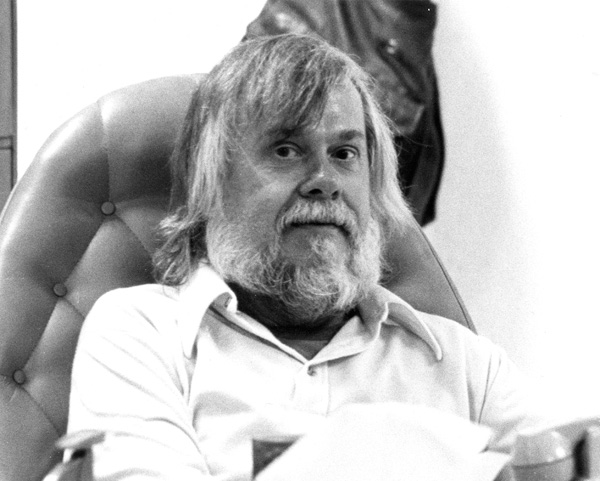
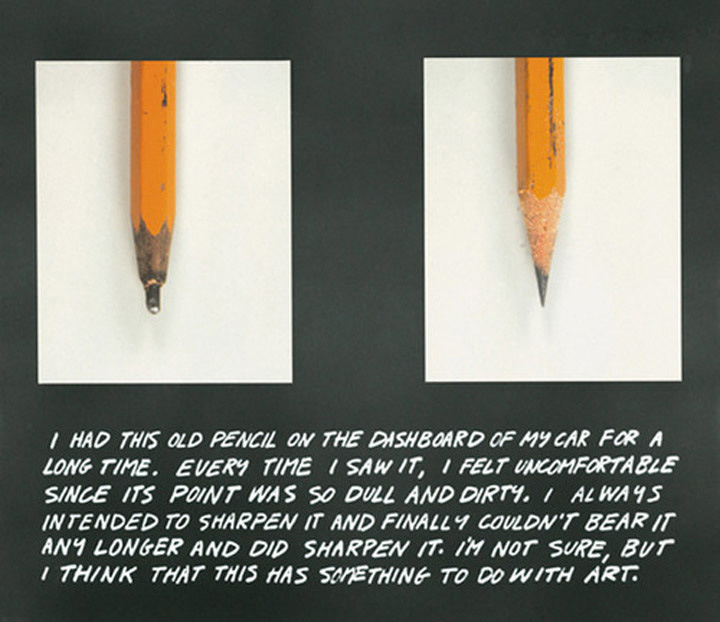
John Baldessari, The Pencil Story, 1972-3. Color photographs, and colored pencil on board, 22 x 27 ¼ in. Courtesy of John Baldessari.
CK: How did the infamous Post Studio class—
JB: I was hired as a painter and was a bit frustrated. You know, I really didn’t want to do that, and there were other painters that had been hired, Allan Hacklin, John Mandel.
CK: You hadn’t been painting for five years at that point.
JB: But I guess they didn’t know what else to call me. [laughs] So I went to Paul Brach and I said, “Listen, this is really kind of silly and makes me uncomfortable. Can I devise a class that’s more in keeping with what I’m thinking about?” And he said, “Sure, make me a proposal.” And I thought about it and thought about it, and tried to bring some structure into it, and I thought about calling it conceptual art, but that seemed too narrow and too prescribed. I think I owe the phrase, the title Post Studio, to Carl Andre. I know I didn’t coin it. But it seemed to be more broadly inclusive, that it would just sort of indicate people not daubing away at canvases or chipping away at stone, that there might be some other kind of class situation. And so I elected to use that. And it seemed to work.
CK: So how was the class organized?
JB: Structured?
CK: Yeah.
JB: Basically, I tried to give them sort of a brief history of contemporary art, so they could see that the things I was interested in didn’t come out of the blue sky—that there was some continuity to it all. So a liberal use of slides and overhead projectors instead of books. And since I was on the road a lot in Europe and New York doing shows, I would bring back catalogs, magazines, and talk about the stuff I’d seen. These students had probably the quickest access to information of any art school in the US, I would wager. They didn’t have to wait for it to come into the magazines. And plus the visiting artists. I would have at least one or two a week talking there. And field trips. But not necessarily art related, you know: going into the things that introduced them to culture in the broadest sense, like going to Forest Lawn, or the Hollywood Wax Museum, or what have you. And a lot of times just anything to get out of the studio. One of my tricks was that we’d have a map up on the wall, and somebody would just throw a dart at the map, and we would go there that day. [laughs] They could take their video cameras and still cameras, and do whatever they wanted in just staying out there. Try to do art around where we were.
CK: Was the availability of equipment at CalArts influential in your own work?
JB: Yes, of course. Because this is one of the reasons students and teachers align themselves with an institution where they have access, right? Yeah, sure, I had access to video equipment, film equipment, and so on, sure.
CK: And you hadn’t done any of that before CalArts? Video especially.
JB: No video. I started video there, yeah. And film.
CK: What colleagues on the faculty—either permanent faculty or guest/visiting faculty—were of particular import to you?
JB: Well, I literally, by that time, I sort of was the sort of Cupid between the art world and CalArts. Or the pimp. Or whatever you call it. [laughs]
CK: Cupid or pimp.
JB: You know, I invited everybody I met that seemed interesting to come out in any way they could, and I would not sort of take no for an answer. If they’d say, “Well, I can only come out for a day,” I’d say, “Come for a day.” But if they didn’t have enough money, I would arrange other gigs around town for them, with other colleagues or what have you. I guess the most reticent one was Sol LeWitt. He said no, he didn’t want to go to any teaching institution. And I said, “Well, how about we could meet in a local bar?” He said, “Oh, that would be fine.” So we just hung out in the local bar all day and I talked to him, drank beer. But I mean, that was the whole mistake I could see schools were making, you know, one, if they even thought about artists, they would have to be there on their terms.
CK: Yeah, right. Five, six hours.
JB: I always, I just figured the important thing was to get the artist at all costs. I mean, any that you could manage or any way you could do it. I would pick them up at the airport; I would find places for them to stay. You know, anything. Yeah, I was a pimp, if you think about it. [laughs]
CK: And who among students that you had were—if there were any—who were important to your work?
JB: To my work? That’s probably hard to— There was a certain group of artists and a lot of them moved down here to Santa Monica, where I was living, which was also good. David Salle, for one, moved right down here. And Jim Welling and Matt Mullican immediately come to mind. And then I encouraged them to get places where they could have studios as well, so that began to happen. And then when that began to happen, I began to schedule classes, each week a different studio, so we could meet and see the work that was going on and what have you. And then, there was this trade-off I told you of people working on various people’s work. So I would help on students work when they needed help and vice versa, and— Oh, and the other important thing, too, is an attitude I tried to develop, was that you were an artist when you walked in the door. We’d break down this relationship of student and teacher. We just had more years on them, that was all, but we fully accepted them as artists, and that helped a lot, too. The teaching didn’t stop when the day was over, class was over, or what have you. Students either would be visiting me or I would be visiting them.
CK: Is there any specific relationship or types of relationships that you see between your work as a teacher and your work as an artist?
JB: The reason I got into teaching was that it was the closest thing to art I could be doing to make a living; it wasn’t art, and it wasn’t actually teaching. And then I just decided, “Well, listen, it looks like I’m going to be doing this most of my life, and I’m going to have fun doing it,” so I decided to make it as much like art as I could, given the parameters of the teaching situation. I finally think it came to a point like that, that one will loop back on through the other, that my art would be sort of an example or illustrative or a metaphor, for what things I was dealing with in class. And I was going at my class much like I would do art, which was basically trying to be as formed as possible but open to chance. [laughs]

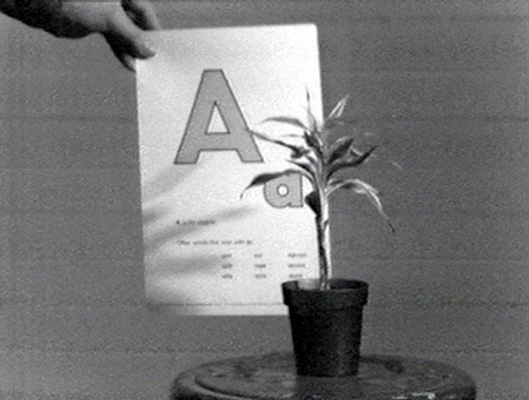
John Baldessari, still from Teaching A Plant the Alphabet, 1972. Black and white video, 19 min. Courtesy of John Baldessari.
CK: You know, I think specifically of— I don’t know if I have the right name of the tape, but the
Teaching a Plant the Alphabet. Is that what it’s called?
JB: Yeah.
CK: The first time I saw that tape it was—
JB: The stupidest idea in the world.
CK: It was a long time ago. No, but the first I thought was, I wonder which of his students was the plant? [laughs]
JB: Well, that’s another tape called
Teaching a Vegetable the Alphabet. [laughs]
No. Well, the whole idea was to raise the question what do you do in an art school? And you say, “Well, what courses are necessary to teach?” and that is question begging in a way, because you can say, “Well, can art be taught at all?” And, you know, I prefer to say, “No, it can’t. It can’t be taught.” You can set up a situation where art might happen, but I think that’s the closest you get. Then I can jump from there into saying, “Well, if art can’t be taught, maybe it would be a good idea to have people that call themselves artists around. And something, some chemistry, might happen.” And then the third thing would be that to be as non-tradition-bound as possible, and just be very pragmatic, whatever works. You know, and if one thing doesn’t work, try another thing. My idea was always you haven’t taught until you see the light in their eyes. I mean, whatever. Extend your hand, that’s what you do. Otherwise, you’re like a missionary, delivering the gospel and leaving. [laughs]
This is an edited version of a much longer oral history interview in the public domain. To read the entire transcript click here.