Artists at Work: A Conversation with Michele O’Marah
by Jennifer Krasinski
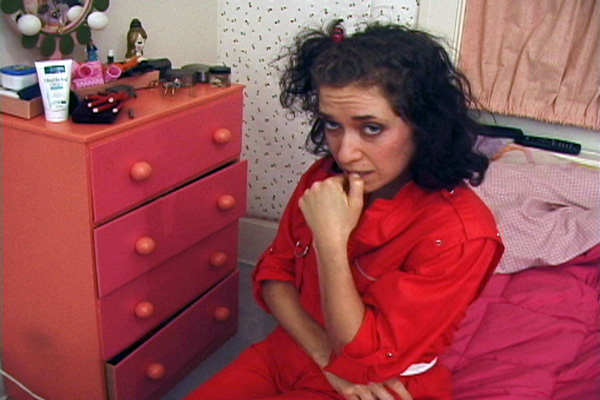
Michele O’Marah, Valley Girl, 2002 (still). Digital video, 113 min. All images courtesy of the artist and Brennan & Griffin, New York.
For nearly fifteen years, Los Angeles–based video artist Michele O’Marah has handcrafted Hollywood remakes and other genre riffs that not only pay a loving homage to their sources and subjects, but also possess a bite sharp enough to pop the hot air out of them. Her disarmingly masterful displays of DIY dazzle—backdrops cut and sewn from construction paper, salvaged props and wardrobe, a cast largely culled from friends and acquaintances, and a shooting strategy that lets the seams show—all provide a welcome antidote to the terminal economies that have infected both art and filmmaking. When we sat down together, our conversation rambled over many topics, including the virtues of failure, the limits of originality, and the ways in which our fictions are lying to us.
Jennifer Krasinski: I always enjoy asking artists this question because I teach: Why did you initially decide to go to art school?
Michele O’Marah: I didn’t go with any intention of being, say, a painter or a photographer or what have you. I just decided that I was going to “be an artist” and “express myself.” I had a painting teacher who literally told me that I was born to paint. He said I had a way with flat shapes and rectilinear form, and I just kept thinking about how painting was kind of boring to me. I remember, there was this Painting 1 assignment where we were told to re-create a masterpiece. My teacher told me “You have to do this Matisse painting. You have to!” So I repainted it, and he thought it was so great, and I just kept thinking, “But it’s not the original painting!”
JK: So you didn’t pursue painting.
MO: Conceptually, I just didn’t get it. I was looking at these works that were hundreds of years old, and they just didn’t make sense to me. But postmodern photography felt so “right now.” I just really liked the whole late eighties: Cindy Sherman, Richard Prince. I just thought it was cool, and I understood it. They were dealing with pop culture and referencing things like the Marlboro Man. I think I was being really dense, and in a way, it was just my conceptual laziness, but I ended up becoming a photography major.
JK: So did you learn photography by re-creating Cindy Shermans and Richard Princes?
MO: [laughs] No.
JK: When did you start making videos?
MO: Not until my senior year. My big senior project was about Jean Harris, the woman who shot and killed Dr. Tarnower, the author of The Scarsdale Diet. I loved the whole crime-of-passion thing—so tabloid but also so dignified because the murder happened in this upper-income, white, suburban New York neighborhood. And I got really deep into the case. I analyzed the court proceedings, made diagrams of the crime scene. My video was pretty terrible. It was all appropriated footage and really “tragic.”
JK: So you appropriated news footage?
MO: No, no, no! That would have been good! It was all taken from Vincent Price movies—beating hearts and bloody stairways and fashion models. It was really melodramatic and over-the-top. I also took a performance class where I made a diagram of the crime scene on the floor with tape. I led people through it and explained exactly how the murder had happened—where the bullet holes were and why her defense made sense. I also explained how Harris was able to reasonably and believably explain how everything happened, but if you were to try to remake the prosecution’s story, it wouldn’t make any sense. I felt really satisfied with that piece because I could prove that she was right.
JK: Having watched all of your work, it makes so much sense that a “true crime investigation” was your earliest remake—that you used it as a means of revealing “the truth.” So then what led you to remake movies, like Martha Coolidge’s Valley Girl [1983]?
MO: I wanted to make a movie but I can’t write, so I thought, “Why would I write one when I can just remake one?” I had that photography background—I learned about Postmodernism and rephotographing—and I understood the concept of appropriation, so it seemed to make the most sense.
JK: Except that appropriation is different from a remake.
MO: I thought of it as a different way to get at the same idea. With appropriation you’re acknowledging that your artwork is a copy of something, and so the work is pointedly false because it’s not the original. But my idea was to fail the original Valley Girl. One person cannot replicate the job of an 80-person film crew. So I thought that my Valley Girl [2002] would be a process piece where the video would at times be a dismal failure or have shining moments and then collapse in on itself because I could never perfectly re-create the original.1
JK: For me, the beauty of that video is that it admits it’s a so-called failure while also pointing to certain failures of the original—or, maybe, the limitations of the original.
MO: I wanted my video to expose the underlying myth of the original: that Prince Charming will pursue you to the ends of the earth. I mean, the initial reason I wanted to do Valley Girl was just that I loved it as a teenager. It was my favorite film, and so many people would tell me how much they loved the movie, too, and I would think about how we were all united by this teen movie that has become a kind of shared memory. But I also felt that it sold young girls this romantic ideal that doesn’t really exist. The idea of remaking it and making the construction of my video really obvious just acknowledged that the story is a construction, too. My version isn’t a fairy tale you’re supposed to believe—even though I didn’t change the story at all and even though it’s a nice story that I really like.
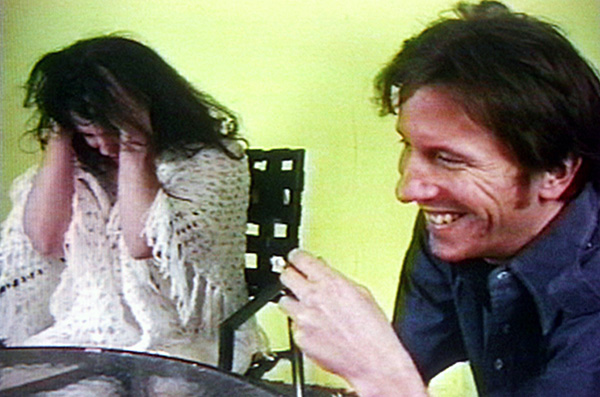
Michele O’Marah, White Diamonds/Agent Orange, 2001 (detail). Digital video, 20 min.
JK: I always liked what Bruce Hainley wrote about your Valley Girl in his review for Artforum, how the piece doubles as “a document of a time period and locale” because you united a community of artists around the making of the video.2
MO: It was amazing, what people did. How dedicated and excited they were. I shot half of it with my close friends Tim Jackson and Caroline Schmitt, who I was living with. David Jones and Kelly Martin did all the music. And Karin Gulbran, Evan Holloway, Jason Meadows, Samara Caughey, and Mark Grotjhan—my circle of friends—were all dedicated to the project, too. Karin made costumes, and Evan gave me part of his studio to shoot in. Mark and Samara both had trucks and would go pick shit up for me. My friend Mary Stevens taught at a private school where they had a really nice video camera, and she would sign it out for me on the weekends. People helped me in so many ways.
JK: Did you choose that kind of DIY approach? There are other artists who would have saved up money to rent studios and equipment, but it seems you were prioritizing something else.
JK: There’s absolutely a different attitude toward production and labor in younger artists. But I’ve noticed that it’s actually a conversation with the baby boomers—the previous generation—that recurs throughout your work. In White Diamonds, Agent Orange [2001], Peacehead [2004], and How Goes It with the Black Movement [2007], you’ve remade very particular moments from their media legacy.
MO: I went to college in the late eighties, early nineties, and they were the generation to look to in order to make sense of the world. So much of what I was studying in college came from them—the art, the movies. But the idea for White Diamonds, Agent Orange was pretty basic. I wanted to remake an interview with Elizabeth Taylor and Richard Burton [from 60 Minutes, 1970] and pair it with a fictionalization of a political event from that era to contrast the depiction of those things because both are outrageous in their own way.3So on the one hand, there’s the liberal decadence of Hollywood—how Taylor and Burton’s conversation sounds so much like a fiction, because it’s so over-the-top.
JK: That interview is nuts! The way they speak freely about the violence of their fights and how they insult one another on camera—and how Taylor defends fighting as a form of loving. In a way, their candor is more shocking than their cruelty toward one another.4
MO: I don’t think we realize how common that kind of openness was at that point, when celebrities could have this attitude of “I’m a semialcoholic and a little bit of a sleaze, but that’s who I am. I’m drinking vodka during my interview. So what? It’s my interview.” And Taylor and Burton also have this kind of entitlement rage. That Liz goes on and on about how she’s a Jew and complains about how people discriminate against her because she’s a Jew—
JK: A converted Jew, as if it’s another role to play.
MO: And next to that, you’ve got the character stereotypes from Vietnam films. Because there’s always a black man in the platoon who’s a super-groovy, jive-talking guy. He’s hip and he’s always into music. And our hero is always some quietly edgy white guy who’s an underachiever until a pressure situation allows him to really excel. Of course, it’s also about genre. I love genre films because you always know what’s going to happen, but when Hollywood looks at history, everything is oversimplified and lacks complexity. And I guess that was what I was really trying to sort out. While Taylor and Burton’s interview is so outside the box—so inappropriate and funny and filled with alcohol and drugs—it was an actual conversation from that time period. And then what happens when you put that up against the fictionalization of war—a kind of compilation of clichéd moments from Vietnam films.
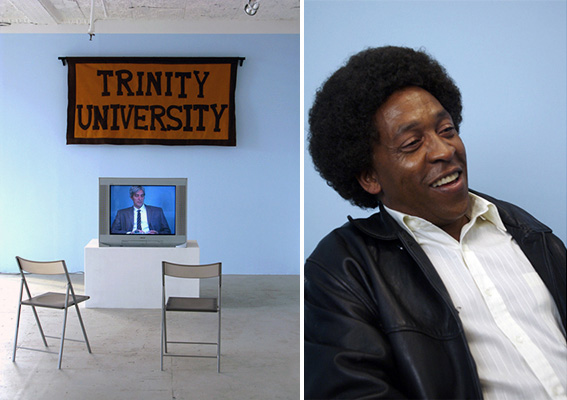
Michele O’Marah, How Goes It with the Black Movement?, 2007. Digital video, 45 min. Left: Installation view at Rental Gallery, New York, October 2007. Right: Henry Taylor as Huey Newton.
JK: It seems to me that How Goes It with the Black Movement (2007)—your remake of William F. Buckley’s interview of Huey P. Newton—is an attempt to undo certain stereotypes, or assumptions, we have about that generation.
JK: One of my responses to that piece was to mourn that particular interview format—remembering that once upon a time, there could be rigorous and difficult political dialogue on television, where people could argue freely about revolution and violence and other “uncomfortable subjects.”
MO: Now you almost never hear anyone say something you don’t expect. They just recite a party line.
JK: Do you just happen upon the material that you know is going to make an interesting piece, or is your process more strategic than that?
MO: For the most part, I’ll see something that will stick in my brain, and then it will become the thing I really want to work on. I actually have so few ideas, but the thing about me is that I can get completely obsessive about working on a project. I think what has saved me from any ignorance of art history or of conversations in contemporary art is a kind of blind dedication I have to an idea. I am obsessive, and I just work really hard.
JK: I was thinking about that in terms of the number of pieces in your most recent installation—Los Angeles Video Portraits: Santa Barbara Installation—a kind of riff on Warhol’s screen tests. How many portraits did you shoot?
MO: Probably like 120. Fifty-three of them ended up in the show. I started doing them around 2005. But to be honest, I did a chunk then, and then I shot another chunk. It would have been nice if I had been doing them as this kind of consistent project, but I haven’t.
JK: What made you want to take on Warhol?
MO: I did it because I love the screen tests, and I always can’t help but think how fantastic those people look and how the films have become a collective portrait of him, his scene, and who was around. And I just thought that I’d like to have glamorous video-portrait documents of my scene and my friends. It was really just that simple.
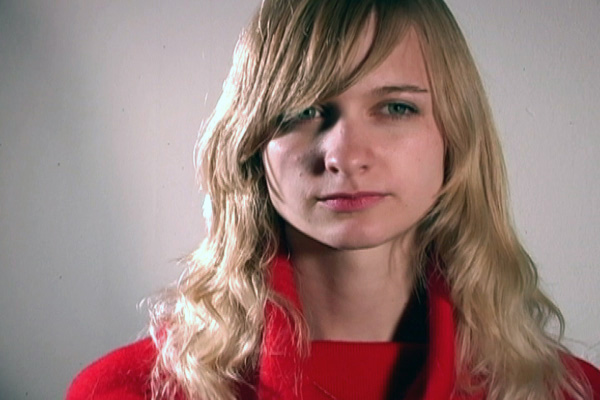
Michele O’Marah, Leslie Vance: Screen Test, 2006-11 (still). Digital video, 4:30 min.
JK: What are you working on now?
MO: I’m doing a project on Isabella Blow. It’s hard, though, because this piece won’t be a remake. It will be an original video.
JK: Are you writing a script?
MO: It’s really more of a shot list. She was such an amazing personality—so funny and acidic. I’m not going to put words in her mouth. That’s too intimidating. She is going to say things, but they’ll be quotes pulled from articles and books and sources like that. I’m mostly trying to build it as a visual piece—to limit the scope of the project to her relationship to aesthetics and to her visual persona. Two books about her have just come out. It’s really her moment right now, which is weird for me because I’ve never made a video about anything so current.
JK: A.S. Hamrah [film critic, editor of N+1‘s film review] once told me a story about an interview he did with Lynda Carter—television’s Wonder Woman—for The New York Observer. He told her about Dara Birnbaum’s Technology/Transformation: Wonder Woman and learned that she’d never heard of it before. It made me wonder if your “source materials” have ever known about or responded to you?